
FHA Loan Down Payment Calculator
Your Inputs
Your Results
Enter your credit score and home price to see your minimum down payment
If you're a first-time home buyer in the U.S., you've probably heard that FHA loans are one of the easiest ways to get into a house. But here’s the real question: What is the minimum credit score for an FHA loan? It’s not as simple as a single number, and getting the wrong info could cost you thousands or delay your purchase by months.
FHA Loans Are Built for People With Lower Credit
FHA loans are backed by the Federal Housing Administration, a government agency created in 1934 to help regular people buy homes when banks wouldn’t. Unlike conventional loans that often demand credit scores of 700 or higher, FHA loans are designed for borrowers with less-than-perfect credit. That’s why over 80% of first-time buyers who use FHA loans have credit scores below 680.
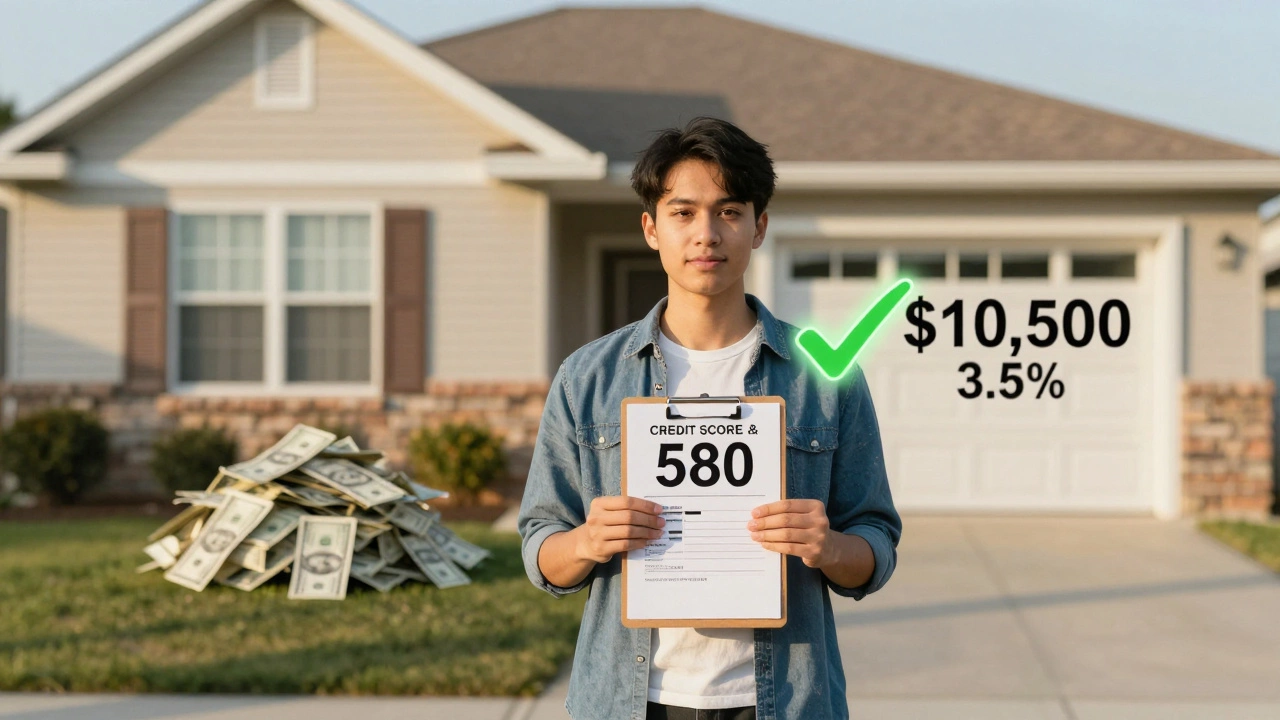
The lowest credit score you can have and still qualify for an FHA loan is 500. But here’s the catch: if your score is between 500 and 579, you’ll need to put down at least 10% of the home’s price. That’s a big jump from the standard 3.5% down payment most people expect.
What Credit Score Do You Actually Need to Get the Best Terms?
Most lenders don’t stop at the FHA’s minimums. Even though the government says 500 is acceptable, private lenders set their own rules - and they’re stricter. Over 90% of lenders require a minimum score of 580 just to approve the loan. Why? Because they’re worried about defaults. A borrower with a 550 score is statistically more likely to miss payments than someone with a 650.
If your score is 580 or higher, you can get the full 3.5% down payment benefit. That means for a $300,000 home, you’d only need $10,500 upfront instead of $30,000. That difference can make or break your ability to buy. In 2025, the average first-time buyer in the U.S. put down $15,600. With a 580+ score, you’re already ahead of the curve.
How Lenders Really Judge Your Credit
It’s not just your FICO score that matters. Lenders look at your whole credit story. They check:
- How many late payments you’ve had in the last 12 months
- Whether you’ve had a foreclosure, bankruptcy, or short sale in the past few years
- Your debt-to-income ratio (how much you owe versus how much you earn)
- How long you’ve had credit accounts open
For example, if you have a 590 score but paid every bill on time for the last 18 months, you’re in better shape than someone with a 620 score who missed two payments last year. Lenders care more about recent behavior than your all-time low.
One common mistake first-time buyers make is applying for new credit right before they apply for a mortgage. Opening a new credit card or taking out a car loan can drop your score by 10 to 30 points. That’s enough to push you from 585 down to 560 - and suddenly, you need 10% down instead of 3.5%.
What If Your Score Is Below 580?
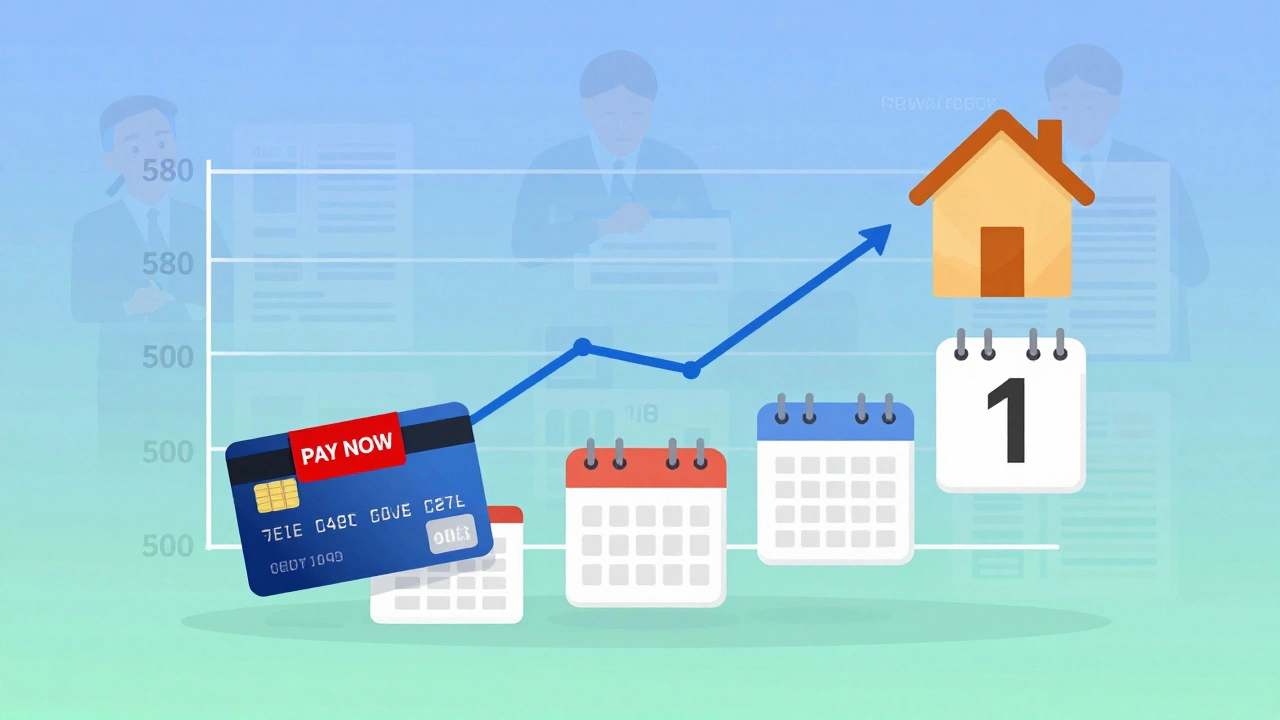
You still have options. First, don’t panic. Many people boost their scores by 50 to 100 points in just 3 to 6 months with simple steps:
- Pay all bills on time - no exceptions
- Reduce credit card balances to under 30% of your limit
- Dispute errors on your credit report (about 20% of reports have mistakes)
- Ask creditors to increase your credit limits (without increasing spending)
- Don’t close old credit accounts - length of credit history matters
One buyer in Atlanta raised her score from 542 to 618 in five months by just paying down $3,000 in credit card debt and disputing two incorrect late payments. She went from needing $20,000 down to $5,000. That’s a $15,000 difference.
Other FHA Loan Requirements You Can’t Ignore
Your credit score isn’t the only thing that matters. FHA loans also require:
- A steady income history - usually two years of W-2s or tax returns
- Proof of U.S. citizenship or eligible non-citizen status
- A home that passes FHA appraisal standards (no major safety issues)
- Mandatory mortgage insurance (both upfront and monthly)
Mortgage insurance is a big cost. For a $300,000 loan with a 3.5% down payment, you’ll pay $1,050 upfront plus about $150 to $200 a month in insurance. That’s $1,800 to $2,400 extra per year. You can’t avoid it unless you refinance later or put down 10% or more.

How FHA Loans Compare to Other Options
Let’s say you’re a first-time buyer with a 600 credit score. Here’s how your options stack up:
| Loan Type | Min Credit Score | Minimum Down Payment | Mortgage Insurance? | Approval Difficulty |
|---|---|---|---|---|
| FHA Loan | 500 | 3.5% (if score ≥580) | Yes | Easy |
| Conventional Loan | 620 | 3% | Only if down <20% | Hard |
| VA Loan | No official minimum | 0% | No | Easy (if eligible) |
| USDA Loan | 640 (typically) | 0% | Yes | Medium |
If you’re eligible for VA or USDA loans, those can be better - no mortgage insurance, lower payments. But FHA wins for most first-timers because it’s widely available, even in cities with high prices.
What Happens If You Get Denied?
Many people think a denial means they’re stuck. It doesn’t. Most FHA denials happen because of:
- High debt-to-income ratio (over 43%)
- Recent bankruptcies or foreclosures
- Not enough documented income
- Errors on credit reports
If you’re denied, ask for a copy of the adverse action letter. It will tell you exactly why. Then, fix it. If your issue is credit, work on it for 4 to 6 months. If it’s income, get a co-signer or wait until you’ve had a steady job longer. There’s no rush. Waiting six months to get your score up could save you $10,000 in down payment.
Bottom Line: What Score Do You Really Need?
The official minimum is 500. The practical minimum is 580. If you’re under 580, don’t give up - fix your credit. If you’re over 580, you’re in the sweet spot. Focus on saving for your down payment, reducing debt, and avoiding new credit applications. Most first-time buyers who succeed with FHA loans don’t have perfect credit. They just have a plan.
Can I get an FHA loan with a 550 credit score?
Yes, but you’ll need to put down at least 10% of the home’s price. Most lenders won’t approve you unless your score is 580 or higher, because they see higher risk. If you can wait and raise your score by even 30 points, you could drop your down payment from 10% to 3.5% - saving thousands.
How long does it take to improve my credit score for an FHA loan?
Most people see a 50 to 100-point increase in 4 to 6 months by paying bills on time, reducing credit card balances, and fixing errors on their reports. Some see changes in as little as 30 days if they pay off a large balance or remove a mistake. The key is consistency - no new debt, no missed payments.
Do FHA loans require a down payment?
Yes. If your credit score is 580 or higher, you need at least 3.5% down. If your score is between 500 and 579, you need 10% down. There are no zero-down FHA loans. But you can use gift money from family members for the down payment, which many first-time buyers do.
Is FHA better than a conventional loan for first-time buyers?
For most first-time buyers with credit scores below 660, yes. FHA loans allow lower credit scores, smaller down payments, and more flexible income rules. Conventional loans have lower monthly mortgage insurance costs if you put 20% down, but you need higher credit to qualify. FHA is the safer, more accessible path for most beginners.
Can I get an FHA loan after bankruptcy?
Yes, but you must wait at least two years after a Chapter 7 bankruptcy discharge or one year after a Chapter 13 bankruptcy if you’ve made all payments on time. You’ll also need to rebuild your credit during that time. Many lenders require a score of 620 or higher after bankruptcy, even though FHA’s official minimum is 500.
Corbin Fairweather
I am an expert in real estate focusing on property sales and rentals. I enjoy writing about the latest trends in the real estate market and sharing insights on how to make successful property investments. My passion lies in helping clients find their dream homes and navigating the complexities of real estate transactions. In my free time, I enjoy hiking and capturing the beauty of landscapes through photography.
view all postsWrite a comment