

Joint Ownership Risk Assessment Tool
Assess Your Co-Ownership Scenario
Answer these questions to evaluate your exposure to common joint ownership pitfallsRisk Meter
Your risk level will appear here after answering all questions
Your Assessment
Buying a home is supposed to be the ultimate financial safety net. It’s stability. It’s equity. But when you add another person to the title-whether it’s your partner, a sibling, or a best friend-that safety net can turn into a trap. You might think splitting the mortgage makes life easier, but joint ownership introduces a layer of complexity that solo buyers never face. The biggest disadvantage isn’t just about money; it’s about losing control over one of your most significant assets.
If you are considering buying property with someone else, you need to look past the romance of "building a future together" or the convenience of pooling resources. You need to understand the legal and financial handcuffs you are putting on yourself. From forced sales to unequal contributions, the downsides of co-ownership can derail your financial plans faster than a market crash.
The Illusion of Equal Contribution
The first major friction point in any joint ownership arrangement is rarely the purchase price-it’s the ongoing costs. Most people enter these agreements assuming everything will be split 50/50. In reality, life rarely divides neatly down the middle. One owner might get a promotion and pay off half the mortgage early, while the other struggles with medical bills. Or one person renovates the kitchen because they hate cooking in the old one, increasing the property value significantly without contributing cash.
Without a legally binding agreement detailing how maintenance, repairs, and improvements are handled, resentment builds quickly. If your co-owner stops paying their share of the council rates or insurance, you still have to pay them, or the bank comes after both of you. This creates a dynamic where one person effectively becomes a landlord to the other, even if they live there together. The stress of managing another adult’s financial reliability adds a hidden tax to your peace of mind.
The Loss of Individual Autonomy
When you own a home alone, you decide when to sell, when to renovate, and who lives in your space. With joint ownership, you lose that unilateral power. Every major decision requires consensus. If you want to move for a job opportunity in Auckland, but your co-owner wants to stay put, you are stuck. You cannot simply pack up and leave. You must negotiate an exit strategy, which often means selling the property at a time that might not be ideal for either party.
This lack of autonomy extends to daily life as well. Can you rent out a spare room? Can you bring in a pet? Can you take out a second mortgage against the property to fund a business? In many joint ownership structures, especially those held as Joint Tenants, one signature isn’t enough. You need permission. This dependency can stifle personal growth and career moves, forcing you to align your entire life trajectory with someone else’s preferences.
Credit Score Contamination
Your credit score is a reflection of your financial behavior. When you buy jointly, your score becomes entangled with your co-owner’s. If they miss a payment, max out their credit cards, or file for bankruptcy, your credit rating takes a hit. Lenders view joint debtors as equally responsible. There is no distinction between "their share" and "your share" in the eyes of the bank.
This contamination effect works both ways, but it is usually a negative force. A strong credit score can open doors to better interest rates and higher borrowing limits. By tying your name to someone with weaker finances, you dilute your own leverage. Even if you pay your half on time, the joint account appears as a single obligation on your credit report. If that relationship sours and leads to legal disputes, lenders may freeze further lending to both parties until the matter is resolved, leaving you unable to access funds for emergencies or new opportunities.

The Divorce of Friends and Family
We often hear horror stories about romantic partners splitting up, but the damage done by co-owning property with friends or siblings can be just as severe. Money is a leading cause of relationship breakdowns. When you mix friendship with real estate, you introduce high-stakes conflict into a bond built on trust and leisure. Disagreements over noise, cleanliness, or guest policies become magnified because they are tied to asset value.
Selling the property to separate lives often feels like a betrayal. One party may feel entitled to stay because they contributed more emotionally or through sweat equity, while the other demands cash based on paper contribution. These disputes frequently end up in court, costing thousands in legal fees and dragging out for months. The emotional toll of turning a loved one into a litigant is a disadvantage that no spreadsheet can quantify, yet it is a very real risk of joint ownership.
Legal Structures and Exit Traps
How you hold the title matters immensely. In New Zealand and many other jurisdictions, you can hold property as Tenants in Common or as Joint Tenants. Each has distinct disadvantages depending on your goals.
| Feature | Joint Tenancy | Tenancy in Common |
|---|---|---|
| Ownership Share | Equal (50/50 regardless of contribution) | Unequal shares possible (e.g., 70/30) |
| Right of Survivorship | Yes (automatic transfer to survivor) | No (share goes to estate/will) |
| Sale Consent | All owners must agree to sell | One owner can sell their specific share |
| Exit Flexibility | Low (hard to exit without consent) | Higher (can sell share to third party) |
The biggest disadvantage of Joint Tenancy is the lack of exit flexibility. You cannot sell your half to a stranger without the other owner’s permission. If the relationship breaks down, you are locked in. Conversely, Tenancy in Common allows you to sell your share, but finding a buyer for a partial interest in a house is difficult and often results in a lower valuation. You are essentially trying to sell a piece of a puzzle rather than the whole picture.
Forced Sales and Market Timing
In a healthy market, selling is easy. In a downturn, timing is everything. Joint ownership removes your ability to wait for the right moment. If your co-owner needs cash for a divorce, a business venture, or simply wants to move overseas, they can force a sale. In some jurisdictions, courts can order the sale of a property to resolve disputes between co-owners, regardless of whether one party wants to keep the home.
This means you could be forced to sell during a market dip, missing out on potential appreciation. You might have been planning to hold the property for ten years to build substantial equity, but your partner’s sudden departure forces a sale after only two years. After transaction costs, stamp duty, and agent fees, you might walk away with little to no profit, despite years of mortgage payments. This loss of control over the investment horizon is a critical financial disadvantage.
Mitigating the Risks
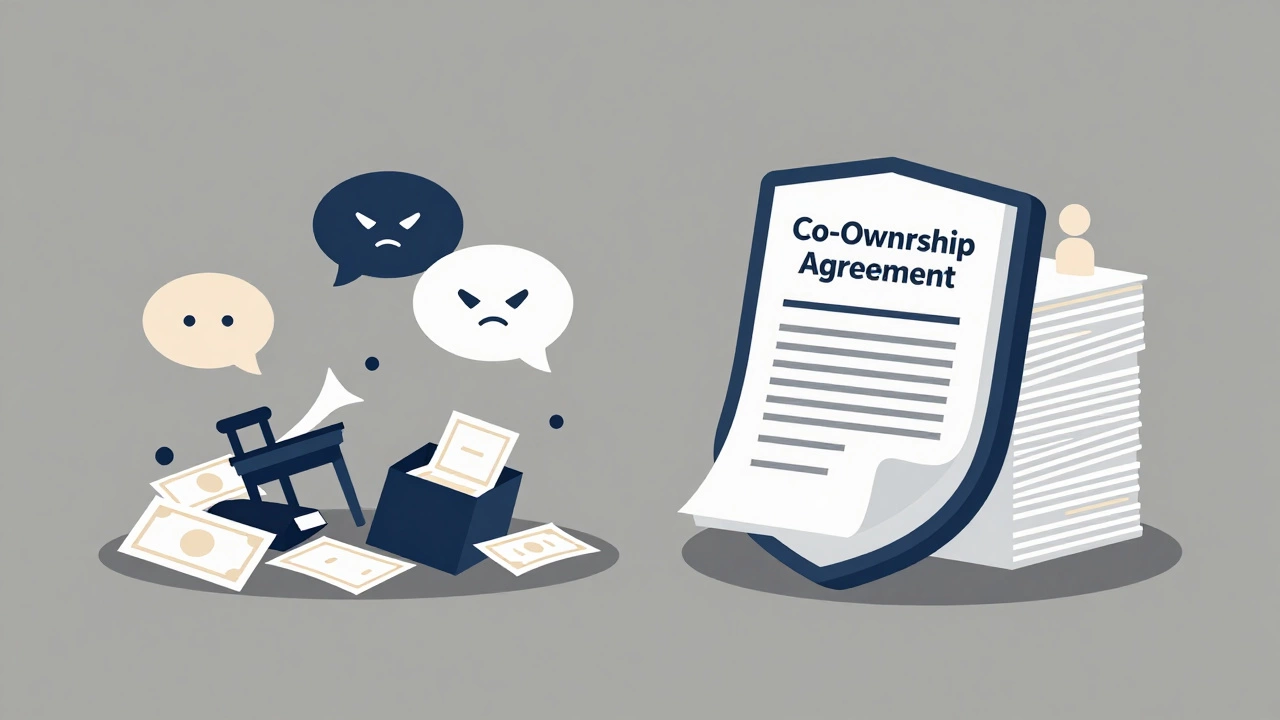
You don’t have to avoid joint ownership entirely, but you must armor yourself. The first step is a Co-Ownership Agreement. This legal document outlines exactly what happens in worst-case scenarios. It should cover:
- Buyout Clauses: Define how much one party must pay to buy out the other if they want to leave.
- Dispute Resolution: Mandate mediation before going to court to save legal fees.
- Contribution Tracking: Keep meticulous records of who pays for what, especially for renovations.
- Death and Disability: Specify what happens if one owner dies or becomes incapacitated.
Additionally, consider using a Trust Structure for holding the property. This can provide more flexibility in managing ownership shares and protecting assets from creditors or relationship breakdowns. While setting up a trust costs money upfront, it is far cheaper than litigation later.
Can I force my co-owner to sell the property?
In most cases, you cannot unilaterally force a sale without legal intervention. However, you can apply to the court for a partition order. If the court agrees that the co-ownership is no longer viable, they may order the property to be sold and the proceeds divided according to ownership shares. This process is expensive and time-consuming.
What happens if my co-owner stops paying the mortgage?
If your names are on the loan as joint borrowers, the lender will pursue both of you for the full amount. Your credit score will suffer if payments are missed. You may need to pay the full mortgage yourself and then sue your co-owner for reimbursement, which is often difficult if they have no assets.
Is it better to be tenants in common or joint tenants?
For non-couples (like friends or siblings), Tenancy in Common is generally safer. It allows for unequal ownership shares based on contribution and gives each party the right to sell their share independently. Joint Tenancy is typically reserved for married couples or partners who want automatic inheritance rights upon death.
Corbin Fairweather
I am an expert in real estate focusing on property sales and rentals. I enjoy writing about the latest trends in the real estate market and sharing insights on how to make successful property investments. My passion lies in helping clients find their dream homes and navigating the complexities of real estate transactions. In my free time, I enjoy hiking and capturing the beauty of landscapes through photography.
view all postsWrite a comment