

Shared Ownership Cost Calculator
Calculate Your Shared Ownership Costs
See how shared ownership compares to full ownership. Enter property details to get monthly cost estimates.
Your Results
Your Equity Share
You own of the property
Housing Association Ownership
They own of the property
Monthly Costs Breakdown
Mortgage Payment:
Monthly Rent:
Service Charges:
Total Monthly Cost:
Compared to full ownership:
What You Should Know
Your equity share grows with the property value. If you staircase, you'll pay for the new share based on current market value, not the original price.
Note: Rental rate is calculated at 2.5% of the remaining property value (standard for shared ownership schemes in New Zealand).
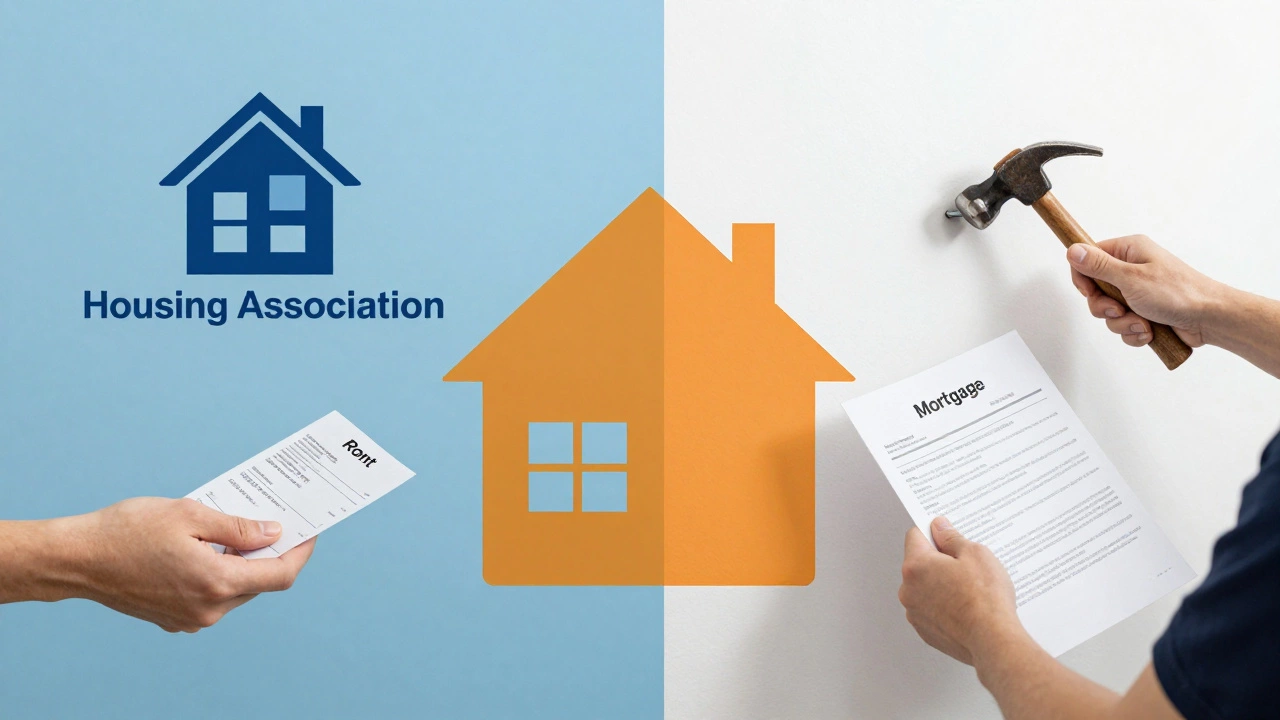
When you hear the term share of ownership, it doesn’t mean you own a piece of a house like you’d own a slice of pizza. In shared ownership homes, it’s a legal and financial arrangement that lets you buy part of a property-usually between 25% and 75%-while paying rent on the rest. This model was created to help people who can’t afford to buy a home outright get onto the property ladder, especially in places like Auckland where prices have soared over the last decade.
What’s the official name for a share of ownership?
The technical term for your portion of ownership in a shared ownership home is an equity share. This isn’t just a casual label-it’s a legally binding percentage tied to your mortgage and the property’s market value. If you buy a 40% equity share in a $600,000 home, you’re paying for $240,000 worth of the property. The remaining 60% is owned by a housing association or a public body, and you pay monthly rent on that portion.
Unlike renting an apartment where you have no claim to the building, your equity share gives you real ownership rights. You can sell your share, improve the property, or even increase your ownership later through a process called staircasing. But you’re not a full owner-not yet. That’s why people often confuse it with renting. It’s both.
How does shared ownership work in practice?
Here’s how it typically plays out in New Zealand and the UK, where the model is most common:
- You find a shared ownership property listed by a housing association or approved developer.
- You choose how much of the property you want to buy-usually 25%, 50%, or 75%.
- You get a mortgage for your share, just like a regular home loan.
- You pay rent on the part you don’t own, usually at a discounted rate compared to market rent.
- You’re responsible for repairs, insurance, and service charges, even on the rented portion.
For example, if you buy a 50% share of a $500,000 home, you’d need a $250,000 mortgage. Your monthly costs might look like this:
- Mortgage payment: $1,200
- Rent on the other 50%: $600
- Service charges and insurance: $150
- Total: $1,950/month
Compare that to buying the whole home outright-where you’d need a $500,000 mortgage and monthly repayments of $2,500+. Shared ownership cuts your upfront cost and monthly burden in half.
Can you own more over time?
Yes. That’s where staircasing comes in. It’s the process of buying additional shares in your home, usually in 10% or 25% increments, until you own 100%. Each time you staircase, the property is revalued, and you pay for the next share based on today’s market price.
Let’s say you bought a 50% share in a $500,000 home. Two years later, the home is worth $580,000. To buy another 25%, you’d pay 25% of $580,000-that’s $145,000. You’re not paying based on the original price. You’re paying based on what the home is worth now.
Staircasing isn’t automatic. You need to qualify for another mortgage, and there are often fees involved: valuation fees, legal fees, and sometimes administration charges from the housing association. Some schemes cap how many times you can staircase, or require you to reach 100% ownership within a certain number of years.

What happens if you want to sell?
If you decide to leave your shared ownership home, you don’t just list it on Trade Me like a regular property. You have to notify the housing association first. They usually have the right to find a buyer for your share within a set time-often 8 to 12 weeks. If they can’t find someone, you can sell it on the open market.
You get to keep the profit from your share. So if you bought 40% for $200,000 and the home is now worth $700,000, your 40% share is worth $280,000. You walk away with $80,000 in profit, minus fees and any outstanding mortgage.
But here’s the catch: you can’t sell the entire property. You can only sell your share. The housing association keeps its portion. That means if you want to move into a bigger house, you can’t take the whole asset with you-you’re only taking your slice of it.
Who runs shared ownership schemes?
In New Zealand, shared ownership is mostly managed by housing associations-non-profit organisations approved by the government. Some are run by local councils, others by community trusts or charities. In the UK, it’s often the Housing Corporation or registered social landlords.
These organisations don’t just own the land-they also set the rules. They decide what percentage you can buy, how much rent you pay, whether staircasing is allowed, and what repairs you’re responsible for. They’re not landlords in the traditional sense, but they do have a say in how you use your home.
Not all shared ownership schemes are the same. Some let you buy up to 100%, others cap you at 80%. Some charge higher rent if you earn over a certain income. Always read the lease agreement carefully. It’s not like a standard tenancy-it’s a hybrid contract with elements of both ownership and tenancy.
What are the downsides?
Shared ownership sounds great, but it’s not perfect. Here are the common pitfalls:
- Higher costs over time: You’re paying both mortgage and rent. Over 10 years, that rent can add up to tens of thousands, even if it’s discounted.
- Valuation surprises: When you staircase, the property is revalued. If prices rise fast, your next share could cost way more than you expected.
- Resale restrictions: You can’t always sell on the open market right away. The housing association has first refusal.
- Complex paperwork: The lease agreement is long, full of legal jargon, and often hard to understand without a lawyer.
- Not eligible for first home buyer grants: In New Zealand, shared ownership properties often don’t qualify for the First Home Grant because you don’t own 100%.
Some people end up stuck-unable to staircase because they can’t get a bigger mortgage, and unable to sell because no one else wants a partial ownership property. That’s why it’s crucial to plan ahead. Ask yourself: Will I want to own 100% in five years? Can I afford the next step?
Who is shared ownership really for?
It’s not for everyone. But it works well for:
- First-time buyers who can’t save enough for a 20% deposit on a full property.
- People with stable income but limited savings-like nurses, teachers, or early-career tradespeople.
- Those who want to build equity without the pressure of a full mortgage.
- People who plan to stay in one place for 5+ years and intend to staircase.
If you’re planning to move in 2-3 years, shared ownership isn’t ideal. The fees, restrictions, and resale process make it harder to exit quickly. It’s designed for long-term living, not short-term investment.
What’s the future of shared ownership?
With housing prices still rising and wages lagging, shared ownership is becoming more popular-not just in the UK, but in cities like Auckland, Wellington, and Christchurch. The government is testing pilot programs to expand access, especially for Māori and Pacific communities.
Some new schemes now allow buyers to start with as little as 10% ownership, with rent-free periods for the first year. Others let you buy shares in multiple homes over time, like a ladder of ownership.
But without clear national standards, the system remains patchy. One housing association might let you staircase freely. Another might charge $2,000 just to process your request. Always check the rules before signing anything.
Final thought: It’s not ownership-it’s a path to ownership
A share of ownership isn’t the same as owning your home outright. But it’s a real step toward it. It gives you security, control over your space, and the chance to build wealth. It’s not a shortcut. It’s a slow, sometimes frustrating, but very real way to get into the housing market when the door’s been shut.
If you’re thinking about it, talk to a housing advisor. Get your finances in order. Understand the lease. And remember: your share isn’t just a percentage on paper-it’s your home, even if you don’t own all of it yet.
What is a share of ownership called in shared ownership homes?
It’s called an equity share. This is the percentage of the property you legally own, which you buy through a mortgage. The rest is owned by a housing association, and you pay rent on that portion.
Can I eventually own 100% of a shared ownership home?
Yes, through a process called staircasing. You can buy additional shares in your home over time, usually in increments of 10% or 25%, until you own it fully. Each step requires a new valuation and often additional mortgage approval.
Do I pay rent on the part I don’t own?
Yes. You pay monthly rent on the portion owned by the housing association. This rent is usually lower than market rates, but it still adds to your monthly costs. It’s not optional-it’s part of the agreement.
Can I sell my share if I want to move?
Yes, but the housing association has the first right to find a buyer. If they can’t find someone within a set period (usually 8-12 weeks), you can sell your share on the open market. You keep any profit from your share, but you can’t sell the whole property.
Is shared ownership cheaper than renting?
Sometimes, but not always. Your total monthly cost includes mortgage payments on your share plus rent on the rest. In some cases, this is cheaper than renting a similar property outright. In others, especially if rent rises or property values jump, it can end up costing more over time. Always compare the numbers carefully.
Corbin Fairweather
I am an expert in real estate focusing on property sales and rentals. I enjoy writing about the latest trends in the real estate market and sharing insights on how to make successful property investments. My passion lies in helping clients find their dream homes and navigating the complexities of real estate transactions. In my free time, I enjoy hiking and capturing the beauty of landscapes through photography.
view all postsWrite a comment