

Down Payment & Closing Cost Estimator
Can you actually buy a house with zero dollars down?
The short answer is yes, but it's not as simple as walking into a bank and getting a key. Most people think they need a massive 20% pile of cash before they can even look at a listing, but that's an old-school rule that doesn't apply to everyone. Depending on the loan you pick, your minimum down payment could be as low as 0% or 3.5% of the home's price. The real question isn't just "how little can I pay?" but "how much will that small payment cost me every month in the long run?"
Quick Takeaways: Minimum Deposit Options
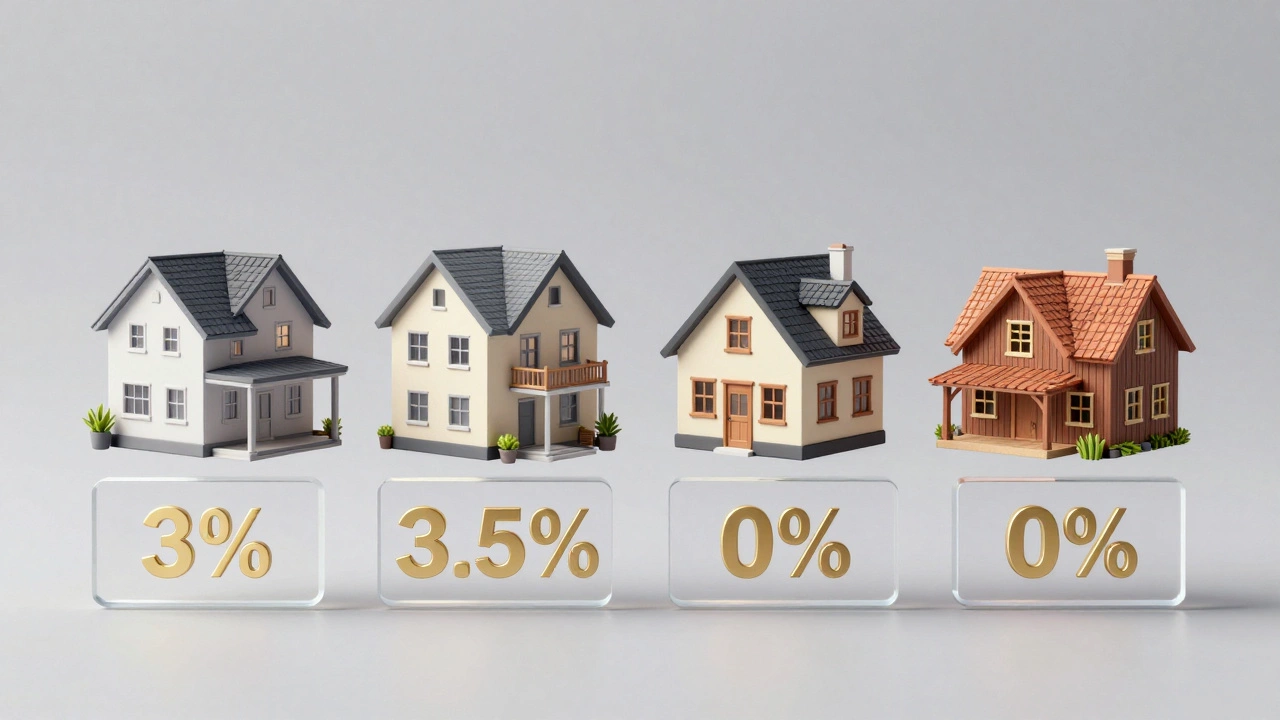
- Conventional Loans: Usually 3% to 5% for first-time buyers.
- FHA Loans: Minimum 3.5% regardless of credit score.
- VA Loans: 0% for eligible veterans and service members.
- USDA Loans: 0% for eligible rural properties.
The low-down on conventional loan deposits
For a long time, conventional loans required a huge chunk of change. Today, many lenders offer programs for Conventional Loans-which are mortgages not insured by the government-that allow for deposits as low as 3%. If you're buying a $300,000 home, that's $9,000. Not bad, right?
But there's a catch called Private Mortgage Insurance (PMI). If you put down less than 20%, the lender will make you pay for a policy that protects them if you default. Think of it as a monthly fee that doesn't go toward your house; it just exists to make the bank feel safe. Once you hit 20% equity in your home, you can usually ask the lender to drop the PMI.
| Loan Type | Min Deposit | Who is it for? | Key Trade-off |
|---|---|---|---|
| Conventional | 3% | Stable income/Credit | Requires PMI until 20% equity |
| FHA | 3.5% | Lower credit scores | Higher permanent insurance fees |
| VA | 0% | Military Veterans | Strict eligibility rules |
| USDA | 0% | Rural residents | Location-specific constraints |
Breaking down the FHA option
If your credit score isn't perfect, the Federal Housing Administration (FHA) is usually the go-to. They insure the loans, which means they're willing to take a bigger risk on you. The minimum down payment here is 3.5%.
Let's look at a real scenario. Imagine you're eyeing a condo for $250,000. With an FHA loan, you'd need $8,750. While that's accessible, you need to be aware of the Mortgage Insurance Premium (MIP). Unlike conventional PMI, which ends at 20% equity, FHA insurance often stays for the entire life of the loan if you put down less than 10%. You're paying for the privilege of a lower entry barrier.
The 0% down possibilities: VA and USDA
Yes, some people can buy a home with absolutely zero dollars down. This isn't a gimmick; it's a government benefit. The VA Loan is provided by the Department of Veterans Affairs. It's arguably the best deal in real estate because there's no down payment and no monthly mortgage insurance.
Similarly, the USDA Loan is designed for people buying in designated rural areas. If you're looking for a farmhouse or a home in a small town, you might qualify for 0% down. The trade-off is that the home must be located in a USDA-eligible zone, which excludes most major city centers.
Why putting more money down is usually better
It's tempting to put down the bare minimum and keep your cash in the bank, but that move comes with a price tag. When you borrow more, your monthly payment is higher because you're paying interest on a larger amount.
Consider two buyers for the same $400,000 house. Buyer A puts down 3% ($12,000). Buyer B puts down 10% ($40,000). Buyer B's monthly payment will be significantly lower, and they'll likely have a lower insurance premium. Over 30 years, that difference can save you tens of thousands of dollars in interest. Plus, you start with more equity, meaning if the housing market dips, you're less likely to end up "underwater"-where you owe the bank more than the house is actually worth.
Hidden costs that your down payment doesn't cover
One of the biggest mistakes first-time buyers make is spending every cent of their savings on the down payment. You need a separate pile of cash for Closing Costs. These are the fees for appraisals, title insurance, attorney fees, and taxes. Usually, these run between 2% and 5% of the home's purchase price.
If you're putting 3.5% down on a $200,000 home, you need $7,000 for the deposit AND maybe another $6,000 for closing costs. If you only have $7,000, you can't actually afford that home. Pro tip: You can sometimes negotiate for the seller to pay a portion of these costs, but in a hot market, that's a tough sell.
How to save for your deposit faster
If you've realized the minimum isn't enough for the house you want, you need a strategy. High-yield savings accounts are a start, but look into Down Payment Assistance (DPA) programs. Many state and local governments offer grants or low-interest second loans to first-time buyers to help them reach that 3% or 5% threshold.
Another trick is the "house hack." Some people buy a home with a low down payment, live in one room, and rent out the others. This allows them to cover the higher mortgage payment and the insurance costs while they build equity faster. It's a grind, but it's a proven way to jumpstart your real estate portfolio.
What happens if I put 0% down?
If you qualify for a VA or USDA loan, you can put 0% down. This means you finance 100% of the home's value. While great for accessibility, it means you start with no equity and will pay the maximum amount of interest over the life of the loan.
Do I always have to pay mortgage insurance?
Not always. If you put down 20% or more, you avoid PMI on conventional loans. With VA loans, you never pay monthly mortgage insurance, although there is often a one-time "funding fee." FHA loans almost always require some form of insurance unless you put down a very large amount.
Can I use a gift for my down payment?
Yes, most lenders allow "gift funds" from family members. You'll just need a signed gift letter stating that the money doesn't need to be paid back. This is a common way first-time buyers bridge the gap to hit the minimum requirements.
Is a 3% down payment enough to be competitive?
The down payment amount usually doesn't affect the seller's decision as much as your overall offer price and your pre-approval letter. However, a larger down payment can sometimes signal to a seller that you are a more financially stable buyer and less likely to have your financing fall through.
What is the difference between a deposit and a down payment?
An "earnest money deposit" is a small amount you pay when you make an offer to show you're serious. This money is usually held in escrow and then applied toward your final down payment at the time of closing.
Next steps for your home search
Before you start scrolling through Zillow, get a pre-approval letter. This tells you exactly how much a bank is willing to lend you and which down payment options you actually qualify for. If you're short on cash, spend a few hours researching your local government's DPA grants-you might find a few thousand dollars in free help that you didn't know existed.
If you're still unsure, try a "stress test" on your budget. Calculate what a 3% down payment monthly cost would be versus a 10% one. If the 3% version leaves you with zero breathing room for car repairs or groceries, it's better to wait six months and save a bit more than to become "house poor" the moment you move in.
Corbin Fairweather
I am an expert in real estate focusing on property sales and rentals. I enjoy writing about the latest trends in the real estate market and sharing insights on how to make successful property investments. My passion lies in helping clients find their dream homes and navigating the complexities of real estate transactions. In my free time, I enjoy hiking and capturing the beauty of landscapes through photography.
view all postsWrite a comment