

Company Share Value Calculator
Calculate Your Share Value
How It Works
Your share value is calculated as:
Current Value = Company Value × Ownership Percentage
Important: This is a hypothetical calculation. Actual value depends on business performance, market conditions, and company policies. Shares in private companies often have restrictions on sale.
Results
Enter values to see your share value calculation
When people talk about shared ownership, most think of homes. But shared ownership isn’t just about property. It’s also a real way for people to own part of a company - and it’s happening more often than you’d think, especially in New Zealand.
What Shared Ownership in a Company Actually Means
Shared ownership in a company means two or more people own a portion of the business together. It’s not about hiring someone to run things while you collect dividends. It’s about having a legal stake - a share - in the company’s profits, decisions, and future value.
Imagine you and three friends start a small café in Ponsonby. You each put in $25,000. You sign an agreement: each of you owns 25% of the business. That’s shared ownership. You don’t just get to say what menu items to add - you also get 25% of the profits at the end of the year. If the café sells for $200,000 five years later, you walk away with $50,000.
This isn’t just for startups. Even established businesses use shared ownership to keep talent locked in. Tech firms in Auckland, like those in the Viaduct Harbour area, often give employees shares as part of their pay package. It’s called an employee share scheme. The idea? If you help grow the company, you grow richer with it.
How It’s Different From Regular Employment
Being an employee and being a co-owner are two completely different things. An employee gets a salary. A co-owner gets a share of the business.
Let’s say you work at a marketing agency as a graphic designer. You earn $70,000 a year. Your boss offers you 2% of the company instead of a $10,000 raise. You take it. Now you’re not just drawing a paycheck - you’re part of the company’s success. If the agency grows and gets bought out for $5 million, your 2% is worth $100,000. That’s a game-changer.
But here’s the catch: if the business fails, you lose your investment. That’s the risk. Shared ownership trades steady income for potential upside. It’s not for everyone.
Types of Shared Ownership in Companies
There are a few common ways people share ownership in a company in New Zealand:
- Shareholders - You own shares in a registered company. These can be ordinary shares (with voting rights) or preference shares (with fixed dividends but no vote).
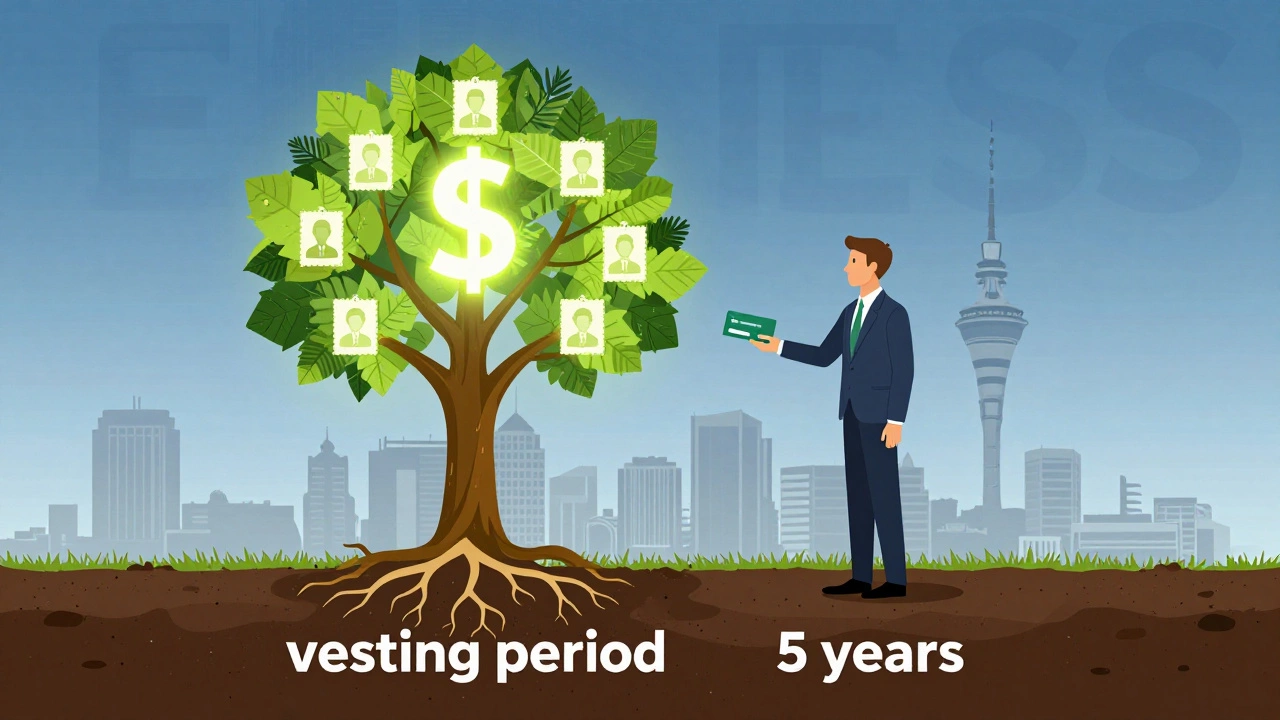
- Employee Share Schemes (ESS) - Companies give or sell shares to staff, often at a discount. These usually come with vesting periods - you have to stay for 2-4 years before you fully own them.
- Partnerships - Common in small businesses like law firms or accounting practices. Each partner owns a percentage and shares both profits and liabilities.
- Co-operatives - Owned by members who use the service. Think of a community-owned solar energy co-op in Tauranga, where members buy shares to fund the project and get discounted power.
Each type has different rules. A shareholder in a public company like Fisher & Paykel Healthcare has no say in daily operations. A partner in a small dental clinic? You’re in every decision - from hiring staff to buying new chairs.
Why Companies Use Shared Ownership
Why would a business give away part of itself? Because it works.
Startups in Auckland’s innovation hubs - like the Spark Centre or the University of Auckland’s startup incubator - often can’t afford to pay top salaries. So they offer equity. A developer who joins a seed-stage app company might get 5% for half the market salary. If the app takes off, that 5% could be worth millions.
Big companies do it too. Air New Zealand has offered shares to staff since the 1990s. In 2023, over 3,000 employees held shares through their ESS. The company says it reduces turnover and boosts loyalty.
Shared ownership aligns everyone’s goals. If you’re a co-owner, you care about costs, customer satisfaction, and long-term growth. You’re not just clocking in - you’re building something.
What You Need to Know Before Joining
If someone offers you a share in their company, don’t just say yes. Ask these questions:
- What percentage do I own? 1% of a $10 million company is $100,000. 1% of a $500,000 company is $5,000. Know the value.
- How do I get my shares? Are they given to you? Bought? Do you have to work for five years before they’re yours?
- Can I sell them? Some agreements lock you in for years. Others let you sell back to the company or to other shareholders.
- What happens if the company sells? Do you get paid out? Or do you have to reinvest in the new company?
- Am I liable for debts? In some structures, like partnerships, you can be personally on the hook if the business owes money. In a limited company, your risk stops at your investment.
Always get legal advice. A lawyer can review the shareholders’ agreement. Don’t skip this. I’ve seen people sign away their rights because they trusted a handshake.
Real Example: A Kiwi Startup Story
In 2021, three mates in Wellington started a software company called LocalLift - an app that connects local tradespeople with homeowners. They each put in $15,000 and split the company 33% each.
Two years later, they hired a fifth person - a coder - and offered her 10% of the company. She took it. Her salary dropped from $85,000 to $65,000, but she got shares.
In 2024, a Sydney-based tech firm bought LocalLift for $4 million. The three founders each got $1.32 million. The fifth employee got $400,000.
She didn’t just get a job. She got a life-changing payout - because she owned part of the business.

Shared Ownership vs. Shared Ownership Homes
People in New Zealand know shared ownership from housing. In that model, you buy a share of a home (say, 25%) and pay rent on the rest to a housing association.
Company shared ownership is the same idea - you own part of something, not all of it. But instead of paying rent on a house, you’re investing in a business. And instead of a housing association, you’re working with other owners.
The key difference? With a home, you live in it. With a company, you build it. The value comes from growth, not shelter.
Who Should Consider Shared Ownership in a Company?
It’s a good fit if:
- You’re early in your career and willing to trade short-term pay for long-term gain.
- You believe in the company’s mission - not just the paycheck.
- You’re okay with risk. Not every startup succeeds.
- You want to be more than an employee - you want to help shape the future.
It’s not for you if:
- You need stable income to cover rent or bills.
- You don’t want to be involved in business decisions.
- You’re not comfortable with uncertainty.
Shared ownership in a company isn’t a shortcut to wealth. It’s a partnership. And like any good partnership, it needs trust, clarity, and effort from everyone involved.
Final Thought: Ownership Changes Everything
People who own part of a company think differently. They notice costs. They fix problems before they become big. They stay longer. They care more.
That’s the power of shared ownership. It doesn’t just give you money - it gives you a stake in the future. And in a country like New Zealand, where entrepreneurship is growing, that’s more valuable than ever.
Can I own shares in a company without working there?
Yes. You can buy shares in publicly traded companies like Air New Zealand or Fisher & Paykel Healthcare through a sharemarket broker. You don’t need to be an employee. But if you’re offered shares directly by a private company, it’s usually tied to working there - especially in startups.
Are shares in a private company worth anything if it’s not selling?
They’re worth what someone is willing to pay for them. Private company shares don’t trade on the stock exchange, so there’s no daily price. But if the company is growing, making profits, or has strong interest from buyers, your shares have value. Many private companies set up a "buyback" option - they’ll pay you for your shares after a few years.
Do I pay tax on company shares?
Yes. If you get shares for free or below market value as part of your job, Inland Revenue treats the difference as taxable income. If you later sell them for more than you paid, you may owe capital gains tax - though New Zealand doesn’t have a general capital gains tax. Exceptions apply if you’re trading shares regularly or if the company is a property developer.
Can I lose money with shared ownership in a company?
Absolutely. If the company fails, your shares could become worthless. That’s the risk. You might lose your entire investment - whether it’s $5,000 or $50,000. Never invest more than you can afford to lose.
What’s the difference between shares and a bonus?
A bonus is cash you get once - maybe at the end of the year. Shares are ownership. They can grow in value over time. A $10,000 bonus is gone in a month. $10,000 in shares could become $100,000 if the company succeeds. Shares are long-term. Bonuses are short-term.
Corbin Fairweather
I am an expert in real estate focusing on property sales and rentals. I enjoy writing about the latest trends in the real estate market and sharing insights on how to make successful property investments. My passion lies in helping clients find their dream homes and navigating the complexities of real estate transactions. In my free time, I enjoy hiking and capturing the beauty of landscapes through photography.
view all postsWrite a comment