

Rental Property 50% Rule Calculator
The 50% rule estimates that approximately 50% of your gross rental income will go toward operating expenses. This calculator helps you determine if a property will generate positive cash flow after applying this rule.
Results
When you buy a rental property, you’re not just paying for the house-you’re buying a business. And like any business, it needs to make money after all the bills are paid. That’s where the 50% rule comes in. It’s not a law. It’s not a guarantee. But for thousands of landlords in the U.S. and U.K., it’s the first filter they use before signing a contract.
What the 50% Rule Actually Means
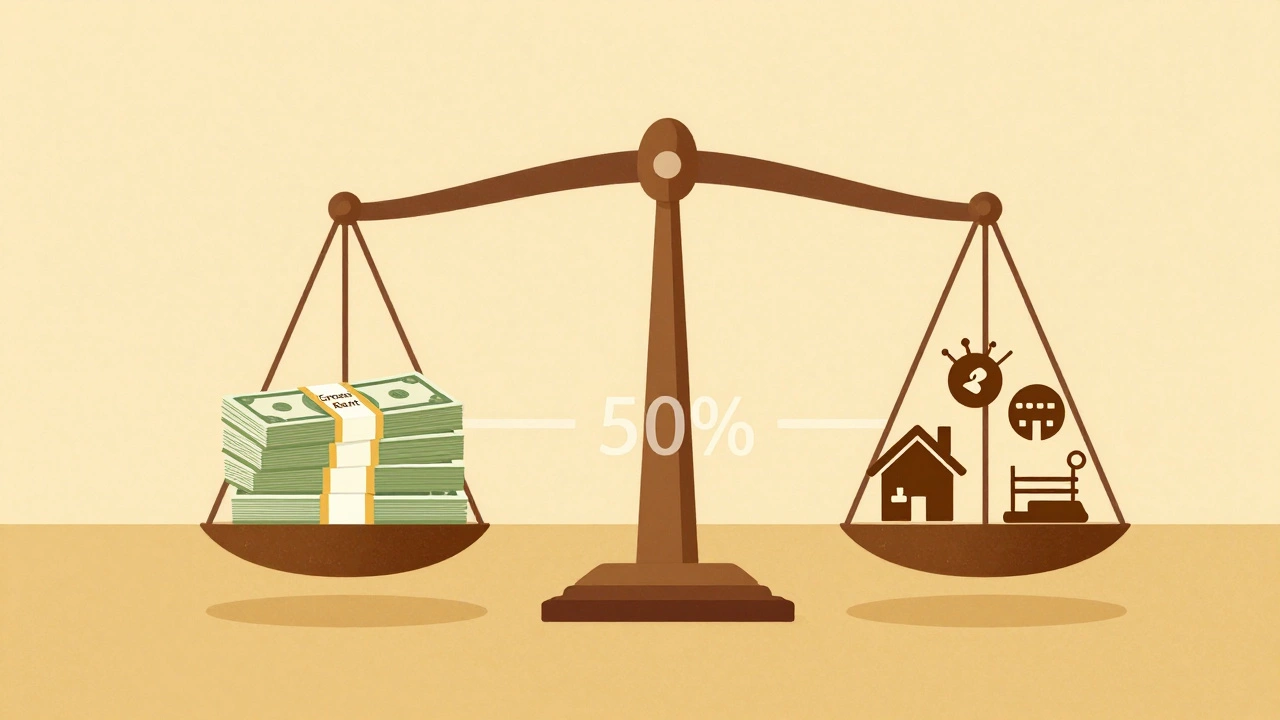
The 50% rule says that about half of your gross rental income will go toward operating expenses. Not mortgage payments. Not taxes on your profit. Just the day-to-day costs of running the property: repairs, maintenance, property management, insurance, utilities, vacancies, and trash collection.
Let’s say you collect $2,000 a month in rent. Under the 50% rule, you should expect to spend roughly $1,000 on expenses. That leaves you with $1,000 to cover your mortgage, taxes, and whatever’s left over is your cash flow.
This rule doesn’t include your mortgage payment. That’s important. Many beginners mix up expenses with debt service. The 50% rule only accounts for the costs that eat into your rental income before you even think about your loan.
Why This Rule Exists
Real estate investors learned this the hard way. In the early 2000s, many bought properties assuming they’d make $1,500 a month in rent and only pay $300 in bills. Then the water heater broke. Then the tenant moved out. Then the insurance went up 20%. Suddenly, they were losing money.
A 2021 study by the National Association of Realtors found that 68% of new landlords underestimated operating costs by at least 30%. The 50% rule was created as a reality check. It’s a conservative estimate based on decades of data from thousands of single-family rentals.
It’s not perfect. But it’s simple. And in real estate, simple beats fancy when you’re trying to avoid a financial surprise.
What Counts as an Operating Expense
Not everything you pay is part of the 50% rule. Here’s what’s included:
- Property management fees (if you use a company)
- Repairs and maintenance (plumbing leaks, paint, broken appliances)
- Property insurance
- Landlord liability insurance
- HOA or condo fees
- Utilities you pay (water, sewer, trash, sometimes electricity)
- Lawn care and snow removal
- Advertising for new tenants
- Legal and accounting fees tied to the property
- Vacancy costs (lost rent when the unit is empty)
What’s NOT included?
- Mortgage principal and interest
- Income taxes
- Capital improvements (new roof, HVAC replacement, kitchen remodel)
- Costs to buy the property (closing fees, inspection, appraisal)
Capital improvements are one-time big-ticket items. They matter, but they’re not monthly expenses. You budget for them separately.
When the 50% Rule Doesn’t Work
The rule is a starting point-not a crystal ball. In some markets, it’s way off.
In cities like Austin or Miami, where property taxes are high and insurance costs have skyrocketed, landlords might spend 60% or even 70% of rent on expenses. In rural areas with low taxes and self-managed properties, you might only spend 35%.
Here’s a real example:
A landlord in Detroit bought a house for $45,000. Rent is $950/month. Expenses: $320 (insurance $80, taxes $110, maintenance $90, vacancy $40). That’s 34% of rent. He’s making solid cash flow after his $500 mortgage.
Meanwhile, a similar property in San Diego rents for $3,200/month. But insurance is $450, taxes are $600, and repairs run $300. That’s $1,350 in expenses-42% of rent. Add in property management ($320) and vacancy ($200), and now it’s 58%.
Location changes everything. That’s why you need to check local data.
How to Use the Rule Before You Buy
Here’s how to apply it in practice:
- Find the gross monthly rent for the property (ask the listing agent or check comparable rentals on Zillow or Realtor.com).
- Multiply that by 0.5 to get your estimated monthly operating expenses.
- Subtract your monthly mortgage payment from the rent.
- Then subtract your estimated expenses.
- If the result is positive and at least $200-$300, it’s worth looking closer.
Example: Rent = $2,100. 50% rule = $1,050 in expenses. Mortgage = $1,200. So: $2,100 - $1,050 - $1,200 = -$150. That’s a loss. Walk away.
Even if you’re paying cash, the rule still applies. You’re still spending $1,050 a month on upkeep. That’s your cost of doing business.
What to Do If the Rule Says No
If the property fails the 50% test, don’t panic. It doesn’t mean it’s a bad investment. It just means you need to dig deeper.
Ask: Can I raise the rent? Maybe the current rent is outdated. Check recent comps. Can I reduce expenses? Maybe you can manage the property yourself instead of hiring a company. Can you negotiate a lower purchase price? A $10,000 discount could flip the numbers.
Or maybe it’s just not the right property. Some houses are better for flipping. Others are better for long-term holds. Not every house should be a rental.

Real-World Tip: Track Your Own Numbers
The best way to understand the 50% rule is to track your own property. Use a simple spreadsheet. List every dollar you spend on the rental for six months. Then calculate the percentage of rent those expenses represent.
One investor in Ohio tracked his expenses for a year. His rent was $1,400. His expenses? $720. That’s 51%. He was right on target. He kept the property.
Another in Florida tracked hers. Rent: $2,800. Expenses: $1,900. That’s 68%. She was shocked. She sold the property six months later and bought one in a lower-tax county.
Real data beats rules of thumb every time.
What Happens If You Ignore the Rule?
Landlords who skip this step often end up in financial stress. They think they’re making money because the rent covers the mortgage. Then a furnace dies. Or a tenant sues. Or the city raises property taxes.
In 2023, the Federal Housing Finance Agency reported that 1 in 5 new buy-to-let investors had negative cash flow in their first year. Most didn’t realize their expenses were that high until it was too late.
The 50% rule doesn’t guarantee profit. But it helps you avoid a costly mistake.
Final Thought: Use It as a Filter, Not a Final Answer
The 50% rule is like a seatbelt. It won’t save you from every crash. But it keeps you from getting hurt in the most common ones.
Use it early. Use it often. But always verify with real numbers. Look at tax records. Talk to local property managers. Ask other landlords what they pay for insurance and repairs.
Real estate isn’t about guessing. It’s about knowing. And the 50% rule gives you a place to start knowing.
Does the 50% rule include mortgage payments?
No, the 50% rule only covers operating expenses like repairs, insurance, property management, and vacancy. Your mortgage payment is separate. You subtract it from your remaining cash flow after expenses.
Is the 50% rule accurate in high-cost cities like New York or San Francisco?
In expensive markets, expenses often exceed 50%-sometimes reaching 60% or more due to high taxes, insurance, and maintenance costs. The rule still works as a filter: if expenses are over 60%, you need a much higher rent or lower purchase price to make it work.
Can I use the 50% rule for multi-family properties?
Yes. The rule applies to duplexes, triplexes, and fourplexes too. Just use total gross rent from all units and apply the 50% estimate to total operating expenses. Larger properties often have slightly lower expense ratios due to economies of scale.
What if my property is new and has no expenses yet?
New properties can be deceptive. Even if everything works now, systems wear out. Estimate expenses based on similar properties in the area. Ask local contractors what they charge for HVAC maintenance, roofing, and plumbing. Don’t assume new means cheap to maintain.
How does the 50% rule compare to the 1% rule?
The 1% rule says monthly rent should be at least 1% of the purchase price. For a $200,000 property, rent should be $2,000. The 50% rule looks at expenses after rent. They’re complementary: the 1% rule helps you pick a property that *can* make money; the 50% rule tells you if it *will* make money after costs.
Corbin Fairweather
I am an expert in real estate focusing on property sales and rentals. I enjoy writing about the latest trends in the real estate market and sharing insights on how to make successful property investments. My passion lies in helping clients find their dream homes and navigating the complexities of real estate transactions. In my free time, I enjoy hiking and capturing the beauty of landscapes through photography.
view all postsWrite a comment