

Shared Ownership Cost Estimator
Based on your inputs, here is the breakdown of your ownership stake:
Total Monthly Commitment
Quick Summary: How Ownership Shares Work
- You buy a percentage (usually 25% to 75%) of the home with a mortgage or cash.
- You pay a monthly rent to a housing association for the share you don't own.
- You are responsible for all maintenance and service charges, regardless of your share size.
- You can increase your ownership over time through a process called staircasing.
- When you sell, you get a percentage of the final sale price based on your ownership share.
Breaking Down the Initial Share Purchase
When you enter a shared ownership agreement, you aren't buying the whole house. You're buying a slice of the equity. For example, if a flat is valued at £200,000 and you buy a 25% share, your purchase price is £50,000. You would then use a deposit (say £5,000) and a mortgage for the remaining £45,000.The crucial part here is that your Mortgage is based only on the share you are buying, not the full market value of the home. This makes the monthly payments significantly more manageable than a standard loan. However, you aren't just paying a mortgage; you're also paying rent on the 75% share still owned by the housing association. This rent is usually subsidized, but it can rise annually based on inflation indices.
Think of it like a hybrid between renting and owning. You have the pride and control of an owner for your 25%, but the financial obligation of a tenant for the rest. It's a strategic entry point into the property market, especially in high-demand cities where prices have decoupled from average wages.
The Path to Full Ownership: Staircasing
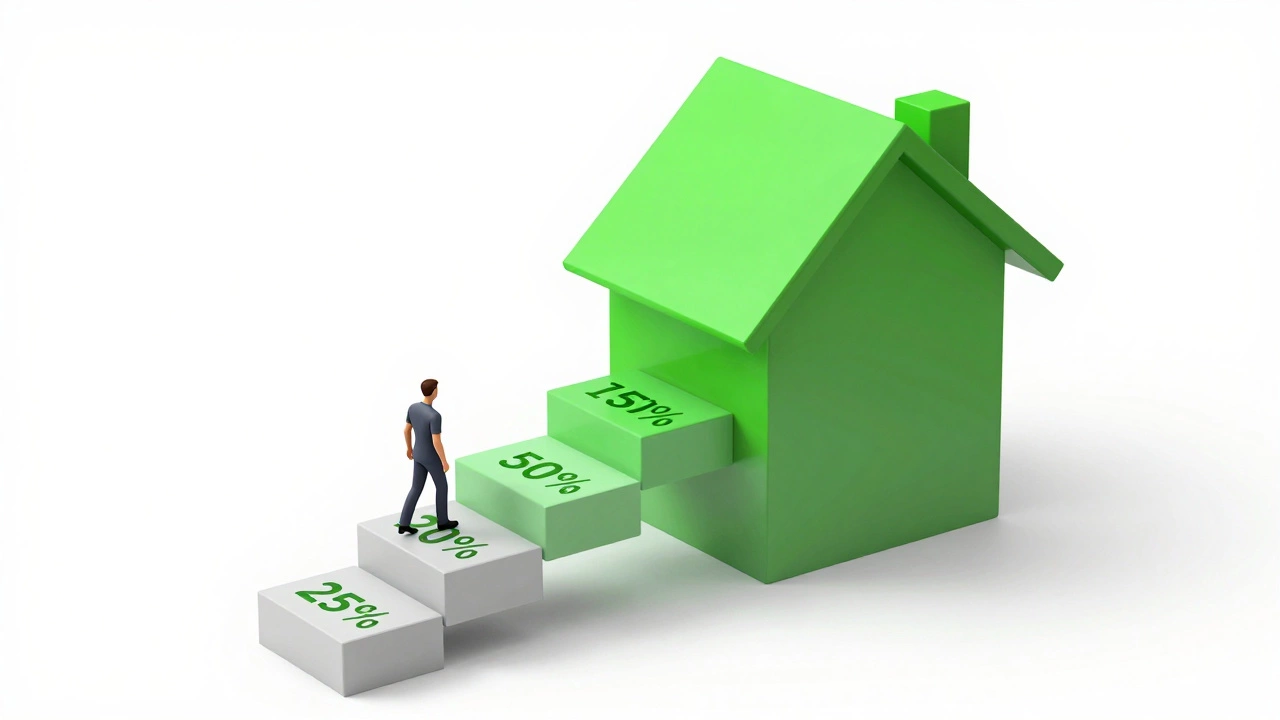
One of the most powerful features of this system is the ability to grow your stake. In the industry, this is known as Staircasing. Essentially, you are "climbing the stairs" toward 100% ownership. You can do this in small increments (like buying another 5% or 10%) or make a leap to 50% or 75%.To staircase, you need to prove you can afford the additional mortgage or have the cash available. You'll need a new valuation of the property, as the price of your next "slice" is based on the current market value, not what you paid originally. For instance, if the home has increased in value to £220,000, buying another 25% share will now cost you £55,000, not the original £50,000.
Why do people do this? Every time you staircase, your rent payment drops because the housing association owns a smaller piece of the pie. Eventually, when you hit 100%, the rent disappears entirely, and you own the property outright. It's a way to build Home Equity incrementally as your income grows.
| Feature | Shared Ownership | Traditional Purchase |
|---|---|---|
| Upfront Deposit | Lower (based on share %) | Higher (based on full value) |
| Monthly Cost | Mortgage + Rent + Service Charge | Mortgage + Service Charge |
| Equity Growth | Proportional to your share | 100% of value increase |
| Maintenance | Owner's full responsibility | Owner's full responsibility |
Managing the Costs of a Partial Share
Here is a bit of a shock for many first-time buyers: owning only 25% of a home does not mean you only pay 25% of the repairs. Whether you own a tiny slice or the whole thing, you are the legal owner. This means if the boiler breaks or the roof leaks, the bill is 100% yours.Then there are Service Charges. Most shared ownership properties are apartments or part of a managed estate. You'll pay a monthly fee for building insurance, hallway cleaning, and landscaping. These costs can be surprisingly high and are not reduced based on your ownership share. If the service charge is £150 a month, you pay £150, regardless of whether you own 25% or 90% of the flat.
It's a common mistake to budget only for the mortgage and rent. You need to account for these fixed costs, which can sometimes feel disproportionately high compared to the amount of equity you actually hold. Always ask for a detailed breakdown of the service charges before signing a contract to avoid nasty surprises.
Selling Your Share: How Profits are Split
When you decide to move on, you don't sell the house in the traditional sense; you sell your share. The process involves finding a buyer who is also eligible for the scheme. The property is valued by an independent surveyor to determine the current market price.Let's look at a real scenario. You bought a 25% share of a £200,000 home (£50,000). Five years later, the home is worth £280,000. Since you own 25%, your share is now worth £70,000. After paying off your remaining mortgage, the profit is yours. The housing association sells their 75% share separately or as part of the same transaction, and they take 75% of the total sale price.
This means you benefit from the market growth on your specific percentage. If the property value skyrockets, your small share grows in value too. However, if the market crashes, your equity drops. You are fully exposed to the risks and rewards of the Real Estate Market, just on a smaller scale.

Potential Pitfalls and Things to Watch Out For
Shared ownership isn't a magic wand; it has specific risks. The biggest one is the "rental trap." If you never staircase, you are essentially paying a mortgage and rent indefinitely. While the rent is subsidized, it still eats into your monthly budget. If rent increases faster than your salary, you might find it harder to save for the next share purchase.Another hurdle is the Mortgage Lender requirements. Not every bank likes shared ownership. Some have strict rules about the minimum share you must buy (e.g., you can't buy less than 25%) or the maximum rent-to-income ratio. You'll need a specialist broker or a lender who understands the nuances of these contracts to ensure you get a fair rate.
Finally, consider the long-term exit strategy. Selling a shared ownership property can sometimes take longer than selling a traditional home because the buyer pool is limited to those who qualify for the scheme. You aren't selling to just anyone; you're selling to someone who fits the government's affordability criteria.
Can I buy a shared ownership home if I already own property?
Generally, no. These schemes are designed for first-time buyers. If you already own a home or have owned one in the past, you typically won't qualify for the subsidized shares. However, some specific developments have different rules, so it's always worth checking the specific housing association's criteria.
How often can I staircase?
There is usually no limit on how often you can buy more shares, provided you can afford the mortgage or have the cash. Some contracts might require a minimum time period between purchases (like 6 or 12 months), but most let you increase your share whenever you're financially ready.
What happens if I can't afford the rent?
Since you have a legal lease, failing to pay rent can lead to repossession, just like missing mortgage payments. If you hit financial trouble, the first step is to contact your housing association. They may offer a payment plan or help you look at options for selling your share.
Do I pay council tax on the whole property or just my share?
You pay council tax on the entire property. Even though you only own a percentage of the equity, you are the sole resident and legal occupant. The local authority does not discount your tax bill based on your ownership share.
Is it better to buy a larger share from the start?
If you can afford it, buying a larger share (like 50% instead of 25%) is usually better. It reduces your monthly rent immediately and means you'll capture more of the property's value increase if prices go up. However, don't overstretch yourself-ensure you have enough left for a safety buffer and home furnishings.
Next Steps for Potential Buyers
If you're considering this route, start by getting a clear picture of your finances. Don't just look at your deposit; look at your monthly cash flow. Calculate what a potential mortgage payment would be for a 25% share and add a rough estimate for rent and service charges.Next, find a mortgage broker who specializes in ownership shares. They can tell you which lenders are currently friendly toward shared ownership and what the current LTV (Loan to Value) requirements are. This prevents you from falling in love with a property only to find out no bank will lend you the money for that specific share percentage.
Finally, visit a few developments. Talk to current residents about the quality of the management and the actual cost of the service charges. Seeing a property in person and understanding the "hidden" costs is the only way to know if this model actually fits your lifestyle and long-term goals.
Corbin Fairweather
I am an expert in real estate focusing on property sales and rentals. I enjoy writing about the latest trends in the real estate market and sharing insights on how to make successful property investments. My passion lies in helping clients find their dream homes and navigating the complexities of real estate transactions. In my free time, I enjoy hiking and capturing the beauty of landscapes through photography.
view all postsWrite a comment