
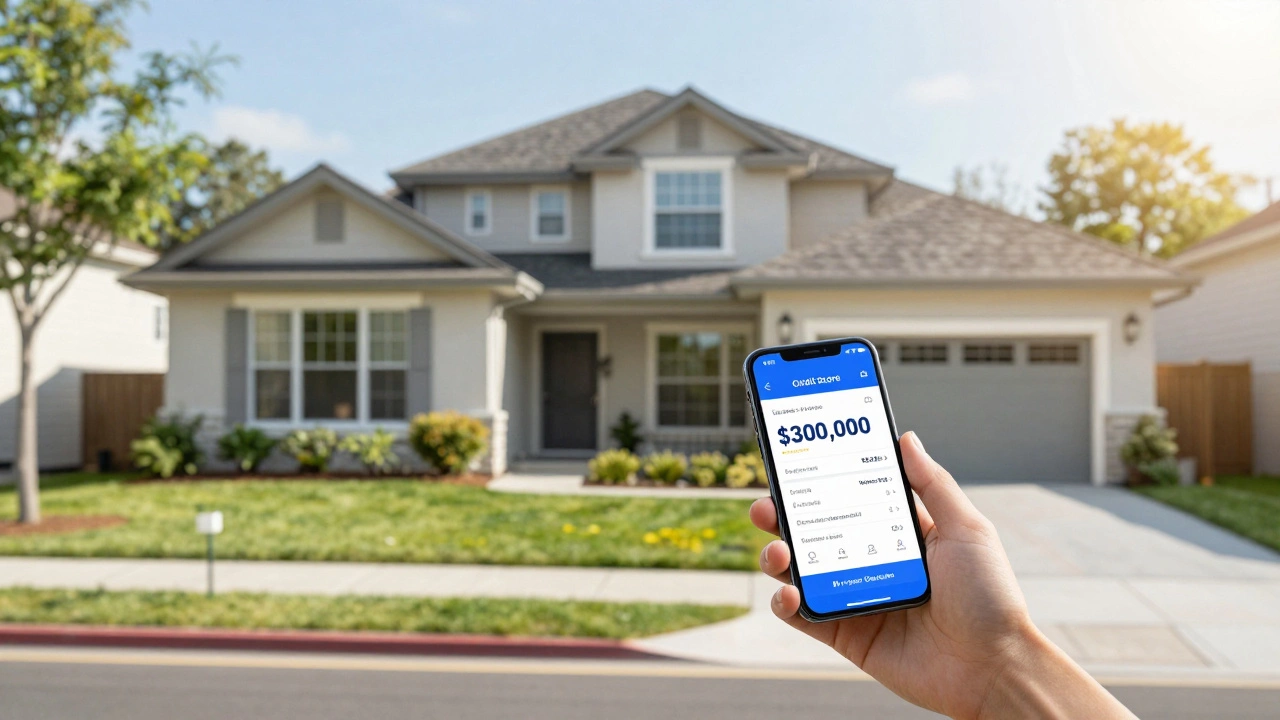
Mortgage Cost Estimator: The Credit Score Impact
Comparison to Top-Tier Credit (740+)
Enter your details to see how much more you might pay.
Quick Takeaways
- Minimums: Most conventional loans require 620, while FHA loans can go as low as 500-580.
- The Sweet Spot: A score of 740+ usually unlocks the lowest possible interest rates.
- Impact: A 100-point difference in your score can cost you tens of thousands in interest over 30 years.
- Alternatives: If your score is low, look into FHA loans or credit unions instead of big national banks.
The baseline numbers you need to know
To buy a $300k house, you first need to decide which loan "bucket" you fit into. FICO Score is the most widely used credit scoring model that predicts a borrower's likelihood of payment. Most lenders rely on this specific version rather than the free scores you see on apps like Credit Karma. For a conventional loan, the floor is usually 620. If you're below that, you're likely looking at a FHA Loan, which is a mortgage insured by the Federal Housing Administration that allows for lower credit scores and smaller down payments. With an FHA loan, you can potentially qualify with a score as low as 580 with a 3.5% down payment. In some rare cases, if you have a strong history, you can go down to 500, but you'll need a 10% down payment to make the lender feel safe.How your score changes the price of a $300k home
Buying a house isn't just about the sticker price; it's about the cost of the money you borrow. Let's be real: a $300,000 home with a 760 score is a completely different financial beast than a $300,000 home with a 620 score. The difference is found in the Interest Rate, which is the percentage of the principal charged by the lender for the use of its funds. Consider this scenario: you put 3% down on a $300k house, meaning you loan $291,000. If you have a top-tier score and land a 6% rate, your monthly principal and interest is about $1,745. If your score is mediocre and you're pushed into an 8% rate, that jumps to roughly $2,137. That's nearly $400 more every single month for the exact same house. Over 30 years, that's over $140,000 in extra money just handed to the bank because of a few points on a credit report.| Credit Tier | Typical Score | Likely Loan Type | Rate Outlook | Monthly Cost (P&I) |
|---|---|---|---|---|
| Excellent | 740 - 850 | Conventional | Lowest available | Lowest |
| Good | 670 - 739 | Conventional / FHA | Average | Moderate |
| Fair | 580 - 669 | FHA / VA | Higher | High |
| Poor | Under 580 | FHA (with high down payment) | Premium | Very High |
Beyond the score: What else do lenders check?
Your score is the headline, but lenders read the whole story. You could have a 700 score, but if you just opened three new credit cards last month, a lender might get nervous. They look at your Debt-to-Income Ratio, often called DTI, which is the percentage of your gross monthly income that goes toward paying debts. For a $300k house, they want to see that your total monthly debts (mortgage, car loans, student loans, credit cards) don't eat up more than 43% to 50% of your pre-tax income. If you make $6,000 a month, but you're spending $2,500 on a fancy car and old student loans, that $300k house might be out of reach even if your credit score is a perfect 850. They aren't just asking "Will you pay?" (credit score), they're asking "Can you afford to pay?" (DTI).Strategies to boost your score before applying
If you're sitting at a 610 and want that conventional loan, don't panic. You can move the needle faster than you think. The quickest way to a jump is by lowering your Credit Utilization Ratio, which is the amount of revolving credit you're currently using divided by the total amount of credit available to you. If you have a credit card with a $5,000 limit and you've spent $4,500, your utilization is 90%. That's a red flag. If you can pay that down to $500 (10% utilization), your score could jump 20 to 50 points within a single billing cycle. Another pro move is the "rapid rescoring" process. If you pay off a large chunk of debt right before applying for a mortgage, your lender can sometimes request a rapid rescore to update your FICO score in days rather than waiting a month for the bureaus to refresh. This can be the difference between a "no" and a "yes" on a $300k home loan.
Common pitfalls for first-time buyers
One of the biggest mistakes people make is applying for a new car loan or financing a new sofa right before they close on a house. Every time you apply for credit, you get a Hard Inquiry, which is a credit check performed by a lender that can temporarily lower your credit score. More importantly, a new loan changes your DTI. If you suddenly owe another $500 a month for a truck, the bank might decide you can no longer afford that $300k house and revoke your pre-approval at the last second. Keep your finances frozen-no new credit, no big purchases-until the day you get the keys.Choosing the right lender for your specific score
Not all lenders are created equal. Big national banks are often rigid; they have a strict "yes" or "no" based on a computer algorithm. If you're on the edge of a credit tier, try a Credit Union, which is a member-owned financial cooperative that often provides more flexible lending criteria than commercial banks. Credit unions are more likely to look at the "human" side of your application. If your score is low because of a medical emergency three years ago, but you've been perfect since then, a local credit union might give you a better rate than a giant bank that only sees a number on a screen. They have more leeway to override a score if your employment history is rock solid.Can I buy a $300k house with a 580 credit score?
Yes, but you'll likely need an FHA loan. While you can qualify, you should expect a higher interest rate and potentially a higher down payment (up to 10%) depending on the lender's specific risk rules. Your monthly payment will be significantly higher than someone with a 740 score.
How much does a 700 credit score help me?
A 700 score puts you in the "Good" range. It generally allows you to qualify for conventional loans, which avoid the expensive mortgage insurance premiums (MIP) associated with FHA loans. You'll get decent rates, though you'll still pay slightly more than someone in the 760+ bracket.
Does the down payment affect the credit score requirement?
Indirectly, yes. A larger down payment reduces the lender's risk (the Loan-to-Value ratio). Some lenders are more willing to overlook a slightly lower credit score if you are putting 20% down because they have a larger equity cushion if you default.
What is a "good" score for the best mortgage rates?
Generally, 740 to 760 is the threshold where you stop seeing significant rate drops. Once you hit this tier, you've effectively "maxed out" your pricing power, and moving from a 760 to an 800 rarely results in a lower interest rate.
Will a co-signer help if my score is too low for a $300k house?
Yes. A co-signer with a strong credit score can help you qualify for a loan you otherwise wouldn't get, and it can even help you secure a lower interest rate. However, the co-signer is equally responsible for the entire $300k debt if you stop paying.
Corbin Fairweather
I am an expert in real estate focusing on property sales and rentals. I enjoy writing about the latest trends in the real estate market and sharing insights on how to make successful property investments. My passion lies in helping clients find their dream homes and navigating the complexities of real estate transactions. In my free time, I enjoy hiking and capturing the beauty of landscapes through photography.
view all postsWrite a comment