

FHA Loan Income & DTI Calculator
Calculate your Debt-to-Income (DTI) ratio and determine the minimum income needed to qualify for an FHA loan based on your current debts and housing costs.
You’ve found the perfect starter home. The price is right, the neighborhood feels safe, and you’re ready to sign on the dotted line. But then comes the question that stops most buyers cold: do I actually make enough money to get approved?
For many first-time home buyers, the Federal Housing Administration (FHA) loan is the golden ticket. It requires a lower down payment than conventional loans and has more flexible credit rules. But there’s a catch that confuses almost everyone: the FHA doesn’t set a specific minimum income.
So, how much do you need to earn? The short answer is: it depends entirely on your monthly bills. Lenders don’t look at your salary in isolation; they look at your ability to repay the loan relative to what you already owe. This guide breaks down exactly how lenders calculate this, what numbers you need to hit, and how to boost your chances of approval in 2026.
The Real Metric: Debt-to-Income Ratio (DTI)
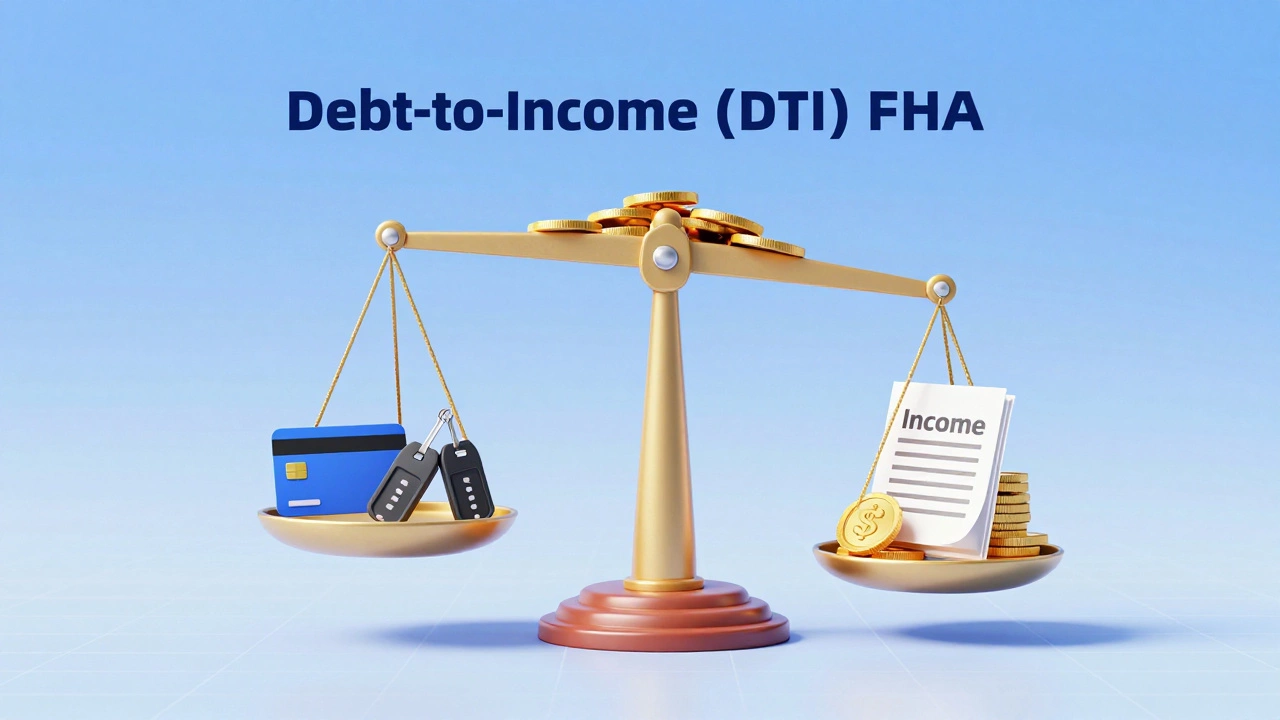
If you are searching for a magic number like "$50,000 a year," you will be disappointed. Instead, lenders use a metric called the Debt-to-Income Ratio (DTI), which is a percentage comparing your total monthly debt payments to your gross monthly income.
Think of DTI as a stress test for your budget. If your debts eat up too much of your paycheck, the lender assumes you won’t have enough left over to handle a mortgage if things go wrong-like a car repair or a medical bill.
To calculate your front-end DTI, lenders divide your projected housing expenses by your gross monthly income. Your back-end DTI is broader; it includes all recurring monthly debts divided by your gross monthly income.
- Gross Monthly Income: Your earnings before taxes and deductions. This includes salary, wages, commissions, bonuses, child support, alimony, and Social Security benefits.
- Total Monthly Debts: Minimum payments for student loans, auto loans, credit cards, personal loans, and any existing mortgages.
The FHA allows a higher DTI than conventional loans, but there are still hard limits. Understanding these limits is the key to knowing if your income is sufficient.
FHA DTI Limits: What Are the Rules in 2026?
The Department of Housing and Urban Development (HUD) sets the baseline guidelines, but individual lenders can add their own overlays. Here is the standard structure you will encounter:
| DTI Tier | Back-End Limit | Lender Requirement |
|---|---|---|
| Standard Approval | 43% | Automatic approval if no compensating factors are needed. |
| With Compensating Factors | Up to 50% | Requires strong credit score, large reserves, or low loan-to-value ratio. |
| Manual Underwriting | Varies | Case-by-case review for complex financial situations. |
A DTI of 43% is the general cutoff. If your monthly debts plus your new mortgage payment exceed 43% of your gross income, you enter the "compensating factors" zone. To get approved with a DTI between 43% and 50%, you usually need one of the following:
- A credit score of 580 or higher (some lenders prefer 620+).
- Sufficient cash reserves (typically 3-6 months of mortgage payments kept in the bank).
- A low Loan-to-Value (LTV) ratio, meaning you are putting down a larger down payment.
If your DTI is above 50%, approval becomes extremely difficult. Most automated underwriting systems will reject the application, and manual underwriters rarely override such high risk unless you have significant assets or a unique employment history.
Calculating Your Minimum Income: A Practical Example
Let’s put this into practice. Imagine you want to buy a $250,000 home in 2026. You plan to put down 3.5% ($8,750). Here is how the math works out.
First, estimate your monthly housing costs. This isn't just the principal and interest. It includes:
- Principal & Interest: Approximately $1,150 (assuming a 6.5% interest rate over 30 years).
- Mortgage Insurance (MIP): FHA requires upfront and annual MIP. Let’s estimate $120/month.
- Property Taxes: Varies by location, but let’s assume $200/month.
- Homeowners Insurance: Roughly $100/month.
Your total monthly housing payment is roughly $1,570.
Now, add your existing debts. Say you have:
- Student Loans: $300/month
- Car Payment: $350/month
- Credit Card Minimums: $150/month
Your total monthly debt obligation is $1,570 + $800 = $2,370.
To stay under the 43% DTI limit, your gross monthly income must be high enough so that $2,370 is only 43% of it.
Calculation: $2,370 / 0.43 = $5,511 gross monthly income.
That translates to an annual salary of approximately $66,132. If you earn less than this, you might still qualify if you have a high credit score and savings, but you would be pushing the boundaries of standard approval.
How Lenders Verify Your Income
Telling the lender you make a certain amount isn’t enough. They need proof. In 2026, the documentation process is streamlined but strict. Depending on your employment type, you will need different documents.
W-2 Employees: If you work for a company, lenders typically ask for:
- The last 30 days of pay stubs showing year-to-date earnings.
- W-2 forms for the past two years.
- Year-to-date profit and loss statements if self-employed components exist.
Self-Employed Individuals: This is trickier. Lenders cannot simply take your current revenue because it fluctuates. They will require:
- Two full years of federal tax returns (including all schedules).
- A year-to-date Profit & Loss statement prepared by a CPA.
- Bank statements for the last two to three months to verify deposits match reported income.
Lenders often average your net income over two years, deducting business expenses. This means your "qualifying income" might be significantly lower than your actual cash flow. If you have had a bad year due to market conditions, you might need to explain it with a letter of explanation.
Non-Traditional Income: Do you receive child support, alimony, or Social Security? These count toward your income, but you must prove they will continue for at least three years. Bank statements showing consistent direct deposits are usually required.

Strategies to Improve Your Qualification
If your income falls short of the calculation, don’t panic yet. There are several ways to improve your standing without waiting for a raise.
1. Reduce Your Debts
The fastest way to lower your DTI is to pay off revolving debts. Paying off a credit card balance eliminates the minimum payment from your DTI calculation immediately. Even paying down a car loan slightly can help.
2. Increase Your Down Payment
While FHA allows 3.5% down, putting more money upfront lowers your monthly principal and interest payment. It also reduces the Mortgage Insurance Premium (MIP) slightly and improves your Loan-to-Value ratio, which acts as a compensating factor for higher DTIs.
3. Add a Co-Borrower
If you have a partner with stable income and good credit, adding them to the loan combines your incomes. However, their debts will also be added to the equation. Ensure their financial profile strengthens, rather than weakens, the application.
4. Shop Around for Lenders
Not all lenders follow HUD guidelines strictly. Some have "overlays" requiring a maximum DTI of 40% or 43%. Others are willing to go up to 50% with manual underwriting. Getting pre-approved from multiple lenders helps you find one that fits your specific financial picture.
Common Mistakes That Kill Applications
Even if you have the right income, small errors can derail your loan. Avoid these pitfalls:
- Opening New Credit Accounts: Applying for a new credit card or car loan during the process increases your potential debt and triggers a hard inquiry, which can lower your credit score.
- Changing Jobs: Lenders want to see stability. Switching jobs or moving from W-2 to self-employment within six months of applying can cause delays or rejection.
- Large Unexplained Deposits: If you suddenly deposit $5,000 into your account, the lender will assume it’s a loan unless you provide proof it’s a gift or savings. Always document large deposits.
Understanding these nuances gives you control over the process. You aren’t just hoping for approval; you are building a case for it.
Is there a minimum income requirement for an FHA loan?
No, the FHA does not set a specific minimum dollar amount for income. Instead, lenders use your Debt-to-Income (DTI) ratio to determine if you earn enough to cover your debts and the new mortgage. As long as your DTI is below 43% (or up to 50% with compensating factors), you can qualify regardless of your absolute income level.
Does student loan debt affect my FHA loan approval?
Yes, student loans are included in your DTI calculation. Lenders will use your actual monthly payment amount if it is greater than 1% of the outstanding balance. If you are on an income-driven repayment plan, you may be able to use the lower payment amount, provided you document it properly.
Can I get an FHA loan with a high debt-to-income ratio?
You can qualify with a DTI up to 50% if you have strong compensating factors. These include a high credit score (typically 580+), significant cash reserves (3-6 months of mortgage payments), or a lower loan-to-value ratio. DTIs above 50% are rarely approved.
How much house can I afford with a $50,000 income?
With a $50,000 annual income ($4,166 monthly gross), and assuming a 43% DTI limit, your total monthly debt payments should not exceed $1,791. After subtracting existing debts (car, student loans, etc.), the remaining amount is what you can spend on housing. For example, if you have $500 in other debts, you could spend about $1,291 on a mortgage, which might qualify you for a home around $200,000-$220,000 depending on interest rates and taxes.
Do gifts count as income for an FHA loan?
Gifts do not count as ongoing income for DTI calculations. However, they can be used for the down payment and closing costs. The donor must provide a gift letter stating the money is a non-repayable gift, and you must show the transfer trail in your bank statements.
Corbin Fairweather
I am an expert in real estate focusing on property sales and rentals. I enjoy writing about the latest trends in the real estate market and sharing insights on how to make successful property investments. My passion lies in helping clients find their dream homes and navigating the complexities of real estate transactions. In my free time, I enjoy hiking and capturing the beauty of landscapes through photography.
view all postsWrite a comment