

Shared Ownership Cost Calculator
How Shared Ownership Works
You buy a share (25%-75%) and pay rent on the remainder. Your monthly costs include both mortgage and rent.
Minimum share: 25% Staircasing: Buy more shares over time Rent rate: 3% annual on unsold share
Your Monthly Costs
Enter property price and share percentages to see your costs
When you hear "shared ownership," you might picture splitting a house with strangers. But in New Zealand and the UK, it’s a real path to owning a home without needing a full mortgage. The big question? How many shares do you need to be an owner? The answer isn’t one number-it’s a ladder you climb over time.
What Shared Ownership Actually Means
Shared ownership isn’t about co-living with roommates. It’s a government-backed scheme where you buy a portion of a home-usually between 25% and 75%-and pay rent on the rest. The housing association or developer owns the part you don’t buy. You get a mortgage for your share, and you pay rent on the rest. Over time, you can buy more shares. That’s called staircasing.
You’re not renting the whole house. You’re not just a tenant. You’re a partial owner. That means you can make changes to your home, you build equity, and you pay less rent than you would if you were renting the whole place. In Auckland, where median house prices hit $950,000 in 2025, shared ownership lets people get on the ladder with as little as $25,000 in savings.
The Minimum Share: 25% Is the Starting Line
You don’t need to buy 100% to be an owner. The minimum share you can buy is usually 25%. That’s the threshold where you stop being a tenant and become a homeowner-just not a full one. At 25%, you own a quarter of the property. You pay a mortgage on that quarter. You pay rent on the remaining 75%.
Let’s say you’re looking at a $600,000 shared ownership home. A 25% share means you buy $150,000 worth. You get a mortgage for that. You pay rent on the other $450,000, which works out to roughly $750 a month (based on 3% annual rent on the unsold share). That’s far less than the $2,500+ you’d pay for a full rental in the same area.
At 25%, you’re already an owner. You have legal rights. You can sell your share. You can increase it. You’re on the path to full ownership.
Staircasing: How You Move Up the Ladder
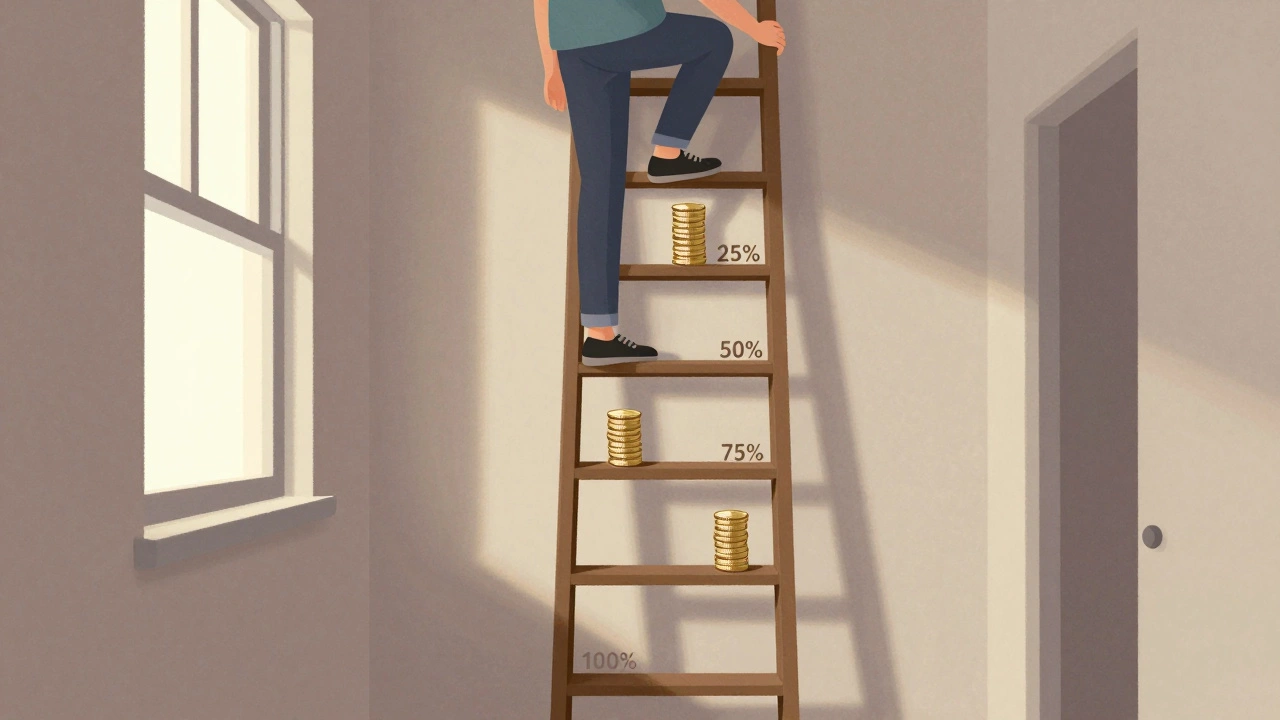
Most people don’t stop at 25%. Staircasing lets you buy more shares-usually in 10% increments. You can do this once a year, sometimes more, depending on your lender and the housing provider. Each time you buy more, your rent drops.
Here’s how it works:
- 25% owned → rent on 75%
- 50% owned → rent on 50%
- 75% owned → rent on 25%
- 100% owned → no rent, full owner
At 75%, you’re paying rent on just a quarter of the home. Your monthly costs drop significantly. Many people aim for 75% because it’s the sweet spot between affordability and control. At that point, you’re paying mostly mortgage, not rent.
There’s no rule that says you have to go all the way to 100%. Some people stay at 50% or 75% forever. They like the lower mortgage payments and the flexibility to sell their share without the burden of full ownership.
Can You Own Less Than 25%? No.
Some people ask: "Can I buy 10%?" The answer is no. Housing providers set 25% as the minimum because it’s the point where you’re legally and financially treated as a homeowner-not a tenant. Below 25%, you wouldn’t qualify for a mortgage. Lenders won’t touch it. And you wouldn’t get the same legal protections.
Also, at 25%, you’re required to pay property insurance and maintenance fees. That’s part of being an owner. Below that, you’d just be a renter with a tiny slice of equity-no real benefit.
What Happens When You Own 100%?
When you buy your last share, you become a full homeowner. The housing association sells you the final portion. Your rent stops. You own the entire property outright. You can sell it, refinance it, or leave it in your will.
But here’s the catch: you still have to pay the market price for the final share. If your home has gone up in value, you’ll pay more than you did for your first share. That’s normal. It’s how equity works.
For example: You bought 25% of a $600,000 home for $150,000. Five years later, the home is worth $800,000. To buy the final 25%, you pay $200,000-not $150,000. That’s a $50,000 gain for the housing association. You still make money because your 75% share is now worth $600,000.

Who Can Buy Shares? It’s Not Just First-Time Buyers
You don’t have to be a first-time buyer. If you’ve sold your home and can’t afford to buy again, shared ownership is an option. If you’re divorced, downsizing, or moving for work, you can still get in. The main rules are:
- Your household income must be under $120,000/year (in Auckland)
- You can’t own another home
- You need a mortgage approved for your share
- You must pass a financial assessment
Many people assume shared ownership is only for young couples. But in 2025, 38% of shared ownership buyers in New Zealand were over 40. Some were empty-nesters. Others were single parents. Age doesn’t matter. Affordability does.
Is Shared Ownership Right for You?
Here’s when it works:
- You want to build equity but can’t afford a full mortgage
- You’re okay with paying rent-even if it’s low
- You plan to stay in the home for at least 5 years
- You don’t mind restrictions on renovations or subletting
Here’s when it doesn’t:
- You want to rent out your home
- You expect house prices to drop
- You need full control over property sales or modifications
- You’re planning to move in under 3 years
Shared ownership isn’t a shortcut. It’s a slow, steady climb. But for thousands in Auckland, it’s the only way to own a home without waiting a decade to save.
What You Need to Know Before You Start
There are three things most people miss:
- Service charges and maintenance fees are separate from rent. You’ll pay $150-$300/month depending on the building.
- You can’t always staircase when you want to. Some providers require a 12-month waiting period between purchases.
- If you sell, you don’t get to pick the buyer. The housing association has the right to find someone who qualifies for shared ownership.
Get a solicitor who knows shared ownership. Don’t use a general real estate lawyer. The legal structure is different. You need someone who’s handled at least five shared ownership sales.
Do you need a mortgage to buy shares in a shared ownership home?
Yes. You need a mortgage to buy your initial share, even if it’s only 25%. Lenders have special shared ownership mortgages that only cover the portion you own. You can’t buy shares with cash alone unless you’re buying the full property outright.
Can you sell your shares at any time?
Yes, but there are rules. You can sell your share at any time, but the housing association has the right to find a buyer who qualifies for shared ownership. You can’t just list it on Trade Me like a regular house. The buyer must meet income limits and pass a financial check.
What happens if house prices drop?
If the home’s value drops, you still owe the mortgage on your share. But you can’t be forced to buy more shares. Your rent is based on the original value of the unsold portion, not the current market price. You’re protected from falling values on the part you don’t own.
Is shared ownership cheaper than renting?
Usually, yes. In Auckland, a 25% shared ownership home costs about $1,300-$1,600/month total (mortgage + rent). A comparable full rental is $2,500-$3,200. You’re saving $900-$1,500 a month-and building equity instead of throwing money away.
Can you ever own 100% of a shared ownership home?
Yes. Most shared ownership schemes allow you to buy up to 100%. Once you do, you’re a full homeowner. You stop paying rent. You own the property outright. You can sell it, leave it in your will, or refinance it like any other home.
Corbin Fairweather
I am an expert in real estate focusing on property sales and rentals. I enjoy writing about the latest trends in the real estate market and sharing insights on how to make successful property investments. My passion lies in helping clients find their dream homes and navigating the complexities of real estate transactions. In my free time, I enjoy hiking and capturing the beauty of landscapes through photography.
view all postsWrite a comment